
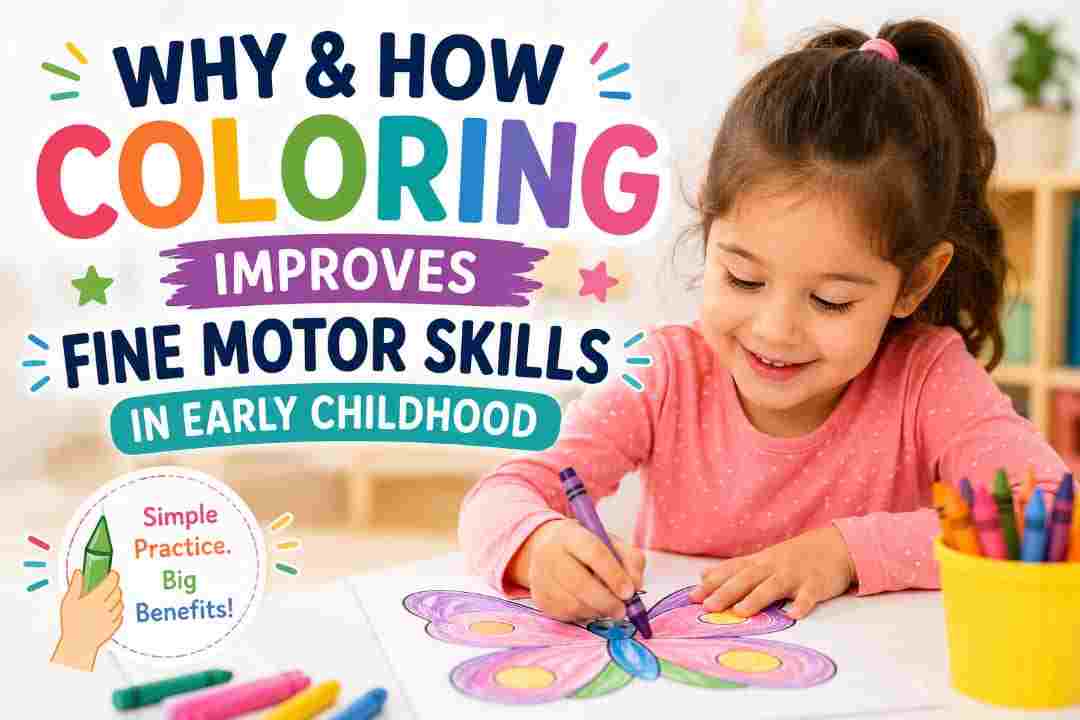
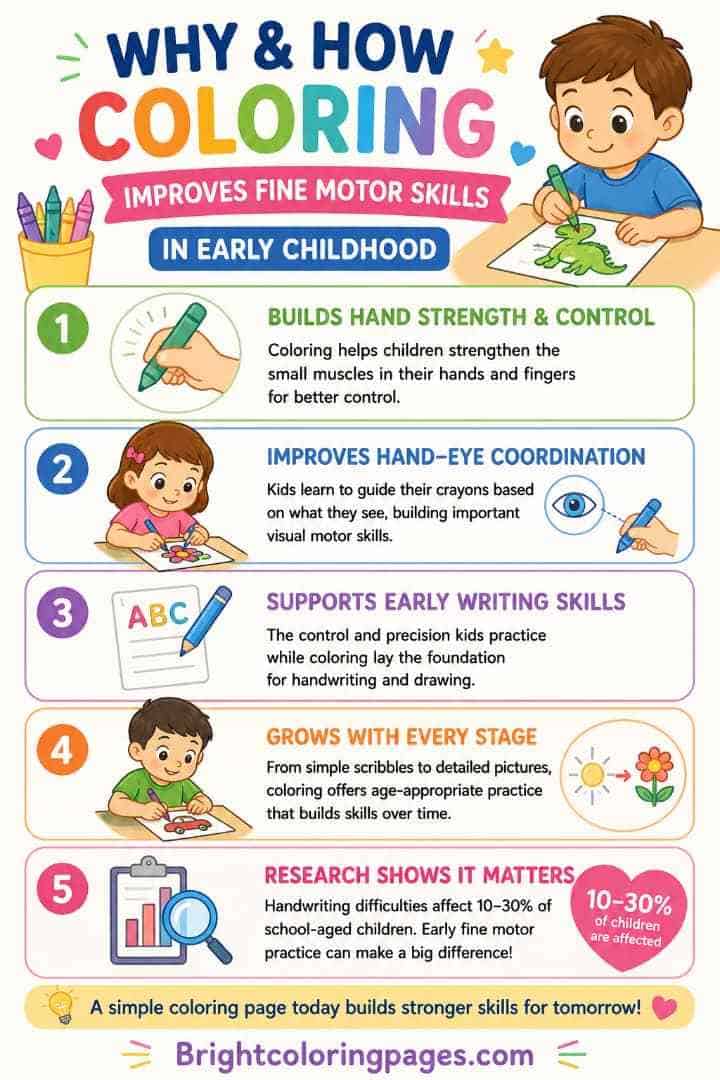
- Coloring strengthens fine motor skills by helping children develop better control of their hands, fingers, and wrists.
- It improves hand eye coordination as children learn to guide crayons and pencils based on what they see on the page.
- Coloring supports early writing skills by building the control and precision needed for handwriting and drawing.
- It provides age appropriate practice that grows with children, from simple scribbles to more detailed coloring activities.
- Research highlights the importance of these skills, with handwriting difficulties affecting an estimated 10 to 30 percent of school aged children, making early fine motor development especially valuable.
Coloring looks simple, but for a young child, it is doing a lot of important work. Each time a child picks up a crayon, they are practicing how to hold a tool, move it with control, and guide their hand based on what their eyes see. That is a big deal in early childhood development.
In fact, fine motor control is one of the core skill areas involved in handwriting, along with visual motor integration, motor planning, and hand awareness.
A review on handwriting development also notes that handwriting difficulties affect between 10 and 30 percent of school aged children, which is a strong reminder that these small skills matter more than many people realize. See the study here.
So how does coloring help? Let us break it down in a simple, practical way.
Coloring gives little hands real practice
Coloring is one of those activities that feels like play, but quietly builds strength and coordination at the same time. When a child colors, they have to hold the crayon, control pressure, and move across the page in a more intentional way.
That repeated practice helps the small muscles in the hand and fingers do their job better over time.
For young children, this is especially helpful because their hands are still learning how to work smoothly. The more often they color, the more familiar they become with the feel of the tool, the movement of the wrist, and the coordination needed to stay on the page. That is exactly the kind of repetition early childhood skills need.
It supports the hand and eye working together
Fine motor skills are not only about strong fingers. They also depend on visual motor integration, which is the ability to coordinate what the eyes see with what the hands do.
That is one reason coloring is such a useful activity. A child looks at the shape in front of them, decides where the color should go, and then guides the crayon to match that plan.
Researchers have even studied coloring as a way to identify children’s visual motor development. In a 2025 PubMed indexed study, a coloring activity was used to assess children’s visual motor integration, and the model reached 86.2 percent accuracy in training data and 80.2 percent accuracy in testing data for identifying developmental status.
That does not mean every coloring page is a test, of course, but it does show that coloring is closely tied to visual motor development.
It builds better control of pencil and crayon movements
One of the first things children learn through coloring is that movement matters. Press too hard, and the crayon may break or make a heavy mark. Press too lightly, and the color may barely show. Move too quickly, and the lines may drift. Move more carefully, and the picture looks more controlled. That kind of feedback helps children naturally refine their grip and movement.
This is why coloring can be such a useful early childhood activity. It gives children a low pressure way to practice control without making them feel like they are being drilled.
They are simply making marks, but those marks are teaching important lessons about force, direction, and precision.
It prepares children for handwriting later on
If you are wondering whether coloring really has a connection to writing, the answer is yes. Handwriting depends on many underlying skills, including fine motor control, visual motor integration, proprioception, and sustained attention.
Coloring helps children rehearse several of those skills in a way that feels fun rather than formal.
The CDC also notes that by age 3, many children can draw a circle when shown how, which is a nice sign of how mark making develops early. Coloring gives children more chances to explore that same world of hand control and visual guidance, one picture at a time. See the CDC milestone guide here.
That is why coloring often works so well as part of school readiness. It is not just about art. It is about preparing the hand, eye, and brain to work together smoothly.
It can be adapted for different ages and stages
One of the best things about coloring is how flexible it is. Younger toddlers may scribble and explore color movement. Preschoolers may try to stay inside larger shapes. Older children can work on smaller details and longer attention spans. The activity grows with the child.
That flexibility makes coloring easy to use at home, in classrooms, or during quiet time. You do not need anything fancy. A few crayons and a page are enough to give a child useful practice. And because the task can be made simpler or more detailed, it can meet children where they are developmentally.
Easy ways to make coloring even more helpful
If you want coloring to support fine motor growth, keep the setup simple and calm. Offer thicker crayons for younger children because they are easier to grasp.
Give short sessions instead of very long ones, especially for toddlers and preschoolers. Choose pages with larger spaces first, then add more detail as the child gets stronger and more confident.
The goal is not perfect coloring. The goal is practice. Each time a child colors, they are rehearsing control, coordination, and attention. That is the kind of repetition that builds real progress over time.
Conclusion
Coloring improves fine motor skills because it gives young children a natural way to practice hand control, visual motor coordination, and careful movement. It supports the same underlying skills that later help with handwriting, drawing, and other everyday tasks.
Research and developmental guidance both point in the same direction: these early mark making experiences really do matter.
And that is the lovely thing about coloring. It looks like a simple activity, but it gives children a strong foundation in a way that feels playful, familiar, and enjoyable.
A child does not need to know they are building fine motor skills. They just need a crayon, a page, and a little time. The learning happens almost naturally from there.
FAQs
Coloring helps children practice holding and controlling a crayon, which strengthens the small muscles in the hand and improves coordination. It also supports the hand and eye working together.
Children can start very early, often in toddler years, with simple scribbling and large shapes. The CDC notes that by age 3, many children can draw a circle when shown how.
Yes. Handwriting depends on fine motor control and visual motor integration, and coloring gives children early practice with both.
Large, simple shapes are best at first because they are easier to manage and less frustrating for small hands. More detailed pages can come later as skills grow.
Yes. A review on handwriting development found that handwriting difficulties affect between 10 and 30 percent of school aged children, which shows why early practice with fine motor tasks is important.