
- Coloring can help adults relax and lower stress after a busy day.
- It encourages mindfulness by keeping attention on one simple, steady task.
- It can interrupt anxious or overactive thinking and create a mental reset.
- It offers an easy, low pressure form of self care that does not require artistic skill.
- In one randomized controlled trial, a 20 minute mandala coloring activity significantly reduced self induced anxiety.
Coloring is one of those activities that looks almost too simple to matter, yet many adults are surprised by how calming it feels once they actually sit down and do it.
It slows the mind, settles the body, and gives your attention something gentle to hold onto. That alone can be a relief in a world that rarely stops asking for more.
That calming effect is not just a nice feeling. Research has found that coloring can reduce anxiety, support mindfulness, and improve well being in adults.
One randomized controlled trial reported that a 20 minute mandala coloring activity significantly alleviated self induced anxiety, while another study found that self guided colouring improved mental health, wellbeing, and mindfulness after repeated sessions.
So if you have ever wondered why adult coloring books became so popular, the answer is pretty simple. They give people a low pressure way to unwind, focus, and feel a little more grounded. Let us look at the five mental health benefits that make coloring worth keeping around.
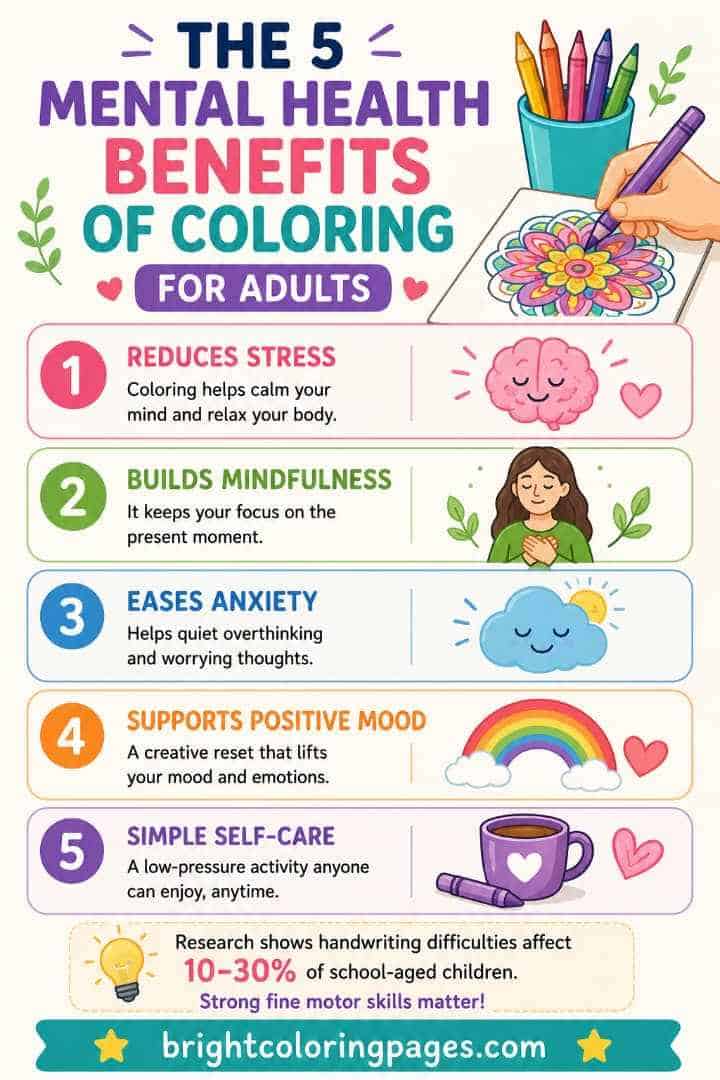
1. Coloring helps reduce stress
Stress is one of the biggest reasons adults turn to coloring. When your day feels full, noisy, or mentally crowded, coloring gives your brain a quieter place to land.
The activity is simple, repetitive, and predictable, which can help the nervous system settle down. Mayo Clinic Health System describes coloring as a healthy way to relieve stress because it calms the brain and helps the body relax.
That matters because stress often shows up as tension, racing thoughts, or a constant sense of being “on.” Coloring creates a small break from that state. You are not trying to perform, solve, or win anything. You are just moving through color and shape at your own pace. That small shift can feel surprisingly refreshing.
2. Coloring encourages mindfulness
Mindfulness is really about being present with what you are doing right now, and coloring is almost designed for that. You look at the page, choose a color, and focus on the next section in front of you.
That steady attention can pull your mind away from scattered thoughts and back into the moment. Research on mindful coloring has found benefits for perceived stress, burnout, and mindfulness in adult groups, including nurses and university students.
What makes this especially useful is that coloring does not demand perfect concentration. If your mind wanders, you simply return to the page. That is a very gentle way to practice focus without turning the activity into another task to master. In my view, that is part of why it works so well for adults who feel mentally tired.
3. Coloring can ease anxious thoughts
When anxiety is high, the mind can start looping through worries over and over. Coloring helps interrupt that pattern by giving your attention a clear and manageable job.
A randomized controlled trial found that 20 minutes of mandala coloring could significantly reduce self induced anxiety, which is a strong sign that this simple activity has real emotional value. See the research here.
That does not mean coloring replaces professional support when someone needs it, but it does mean coloring can be a useful coping tool. It gives the brain something steady to do while the body gets the message that it is safe to slow down. For many adults, that is exactly the kind of reset they need after a stressful stretch.
4. Coloring supports emotional reset and mood
Sometimes the benefit of coloring is not just about lowering stress in the moment. It is also about helping your mood shift in a better direction. Adult coloring gives you a short, creative pause that can feel restorative, especially when the day has been draining or emotionally flat.
Mayo Clinic Health System notes that coloring can improve sleep and fatigue while decreasing feelings of depression and anxiety. Read more here.
That kind of emotional reset matters because adults often push through their days without much space to breathe. Coloring creates a pause that feels private, manageable, and a little soothing. You do not need to be “good” at it. You only need a few minutes and a willingness to let your mind soften a little.
5. Coloring gives you a low pressure form of self care
One of the nicest things about adult coloring is that it is very accessible. You do not need special training, expensive supplies, or artistic confidence to start. You can color for a few minutes or longer, and there is no right or wrong way to do it. That makes it a very low pressure form of self care, which is often exactly what busy adults need.
This matters because a lot of self care advice can feel complicated or unrealistic. Coloring is the opposite. It is easy to pick up, easy to pause, and easy to come back to later. For adults who want something calming that does not require planning, coloring is a practical choice that fits into real life.
A simple stat worth remembering
One of the clearest takeaways from my research is how quickly coloring can help. A published study reported that a 20 minute mandala coloring session significantly reduced self induced anxiety, and another article summarizing adult coloring research noted that some adults experienced benefits with just 10 minutes a day. That is a pretty encouraging reminder that even short sessions can matter. See the study here.
In other words, you do not need to turn coloring into a big project. A short, quiet session can still be meaningful. That is part of what makes it such a useful wellness habit.
Conclusion
Coloring is more than a nostalgic hobby. For adults, it can be a calming, mindful, and emotionally supportive activity that helps reduce stress, ease anxious thoughts, improve mood, and create a low pressure moment of self care. Research backs up that it can be genuinely useful, not just pleasantly relaxing.
The best part is how easy it is to begin. You do not need to be artistic. You do not need to be in the mood for a big creative project. You just need a page, a few colors, and a little time. Sometimes that is enough to help the mind breathe again.
FAQs
Yes. Research and clinical summaries show that coloring can help reduce stress, support mindfulness, and ease anxiety in adults.
Some studies found benefits from short sessions, including a 20 minute mandala coloring activity that significantly reduced self induced anxiety.
Yes. Coloring is often described as a calming activity that helps the brain relax and gives the body a chance to settle.
No. Adult coloring is low pressure and does not require artistic skill. You can simply enjoy the process.
Structured designs like mandalas and detailed patterns are popular because they keep attention steady and create a soothing rhythm.