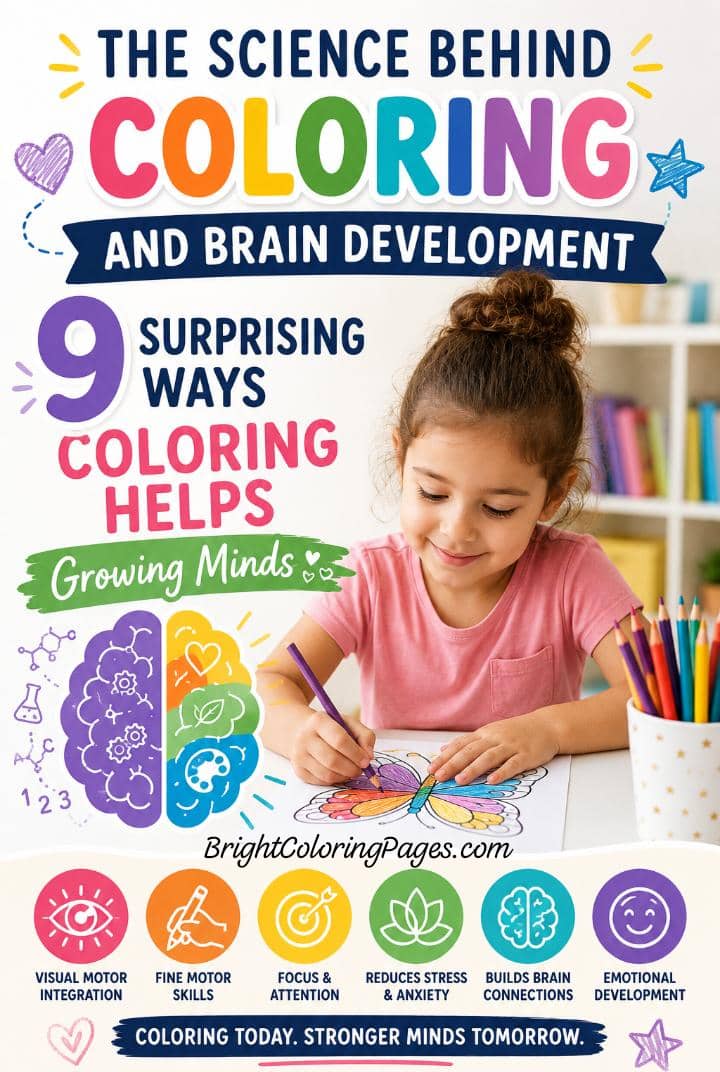
- Coloring is not just a quiet pastime, it engages visual, motor, attention, and emotional systems that are still developing in childhood.
- It strengthens visual motor integration, which is the brain’s ability to guide the hand using what the eyes see.
- Coloring supports fine motor control, grip development, and hand eye coordination, all of which matter for handwriting and school readiness.
- Research and expert guidance also show that coloring can promote mindfulness, reduce stress, and help children and adults stay grounded in the present moment.
- The activity is simple, low cost, and easy to repeat, which makes it a practical tool for learning and emotional regulation.
Introduction
Coloring may look like a simple childhood activity, but there is a lot going on underneath the surface. When a child picks up a crayon, looks at a shape, chooses a color, and tries to fill the space, the brain is doing real work.
It is coordinating vision, movement, attention, planning, and self control all at once. That is one reason coloring keeps showing up in conversations about early learning and child development.
What is especially interesting is that coloring is not only useful for young children. Adults also use it as a calming activity because it can promote mindfulness and help the mind step away from stressful thoughts for a while.
In my view, that combination of developmental value and emotional comfort is what makes coloring such a powerful tool.
What Happens in the Brain When a Child Colors?
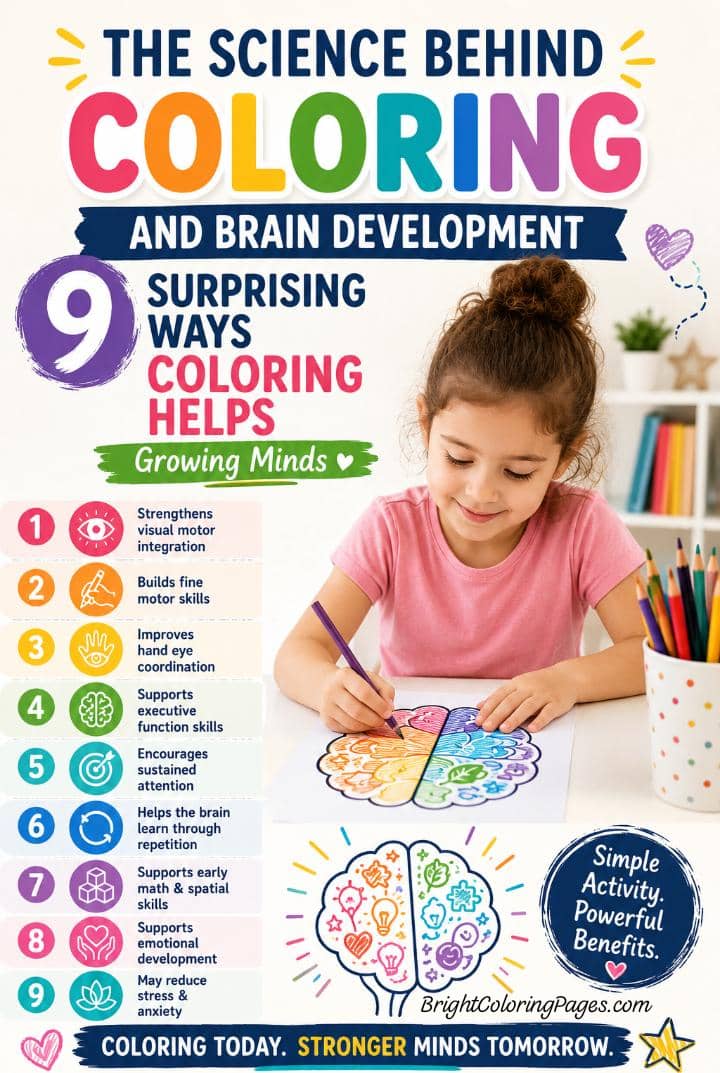
When a child colors, the brain is not just looking at a picture. It is making tiny decisions, sending movement signals to the hand, and checking whether the crayon is going where it should go.
That means several systems are working together, including visual processing, motor control, attention, and emotional regulation.
This is important because early childhood is a time when those systems are still developing. Repeated simple tasks help children practice the skills they will later need for writing, school tasks, and everyday life. Coloring gives them a structured way to practice without pressure.
1. Coloring Strengthens Visual Motor Integration
Visual motor integration is the ability to use what the eyes see to guide the hands. That skill matters for everything from writing to drawing to cutting with scissors. Coloring gives children repeated practice in that exact process.
A 2023 study of 370 kindergarten children found that performance on coloring activities was associated with visual motor integration, and the study reported moderate associations between activity performance and VMI scores.
That is a strong sign that coloring is more than play, it is also a useful developmental task.
2. Coloring Builds Fine Motor Skills
Fine motor skills are the small hand and finger movements children need for writing, eating, dressing, and many classroom tasks. When a child grips a crayon, changes pressure, or tries to stay inside a line, those small muscles get a workout.
Research on preschool children has shown clear developmental progression in pencil and crayon grip. One classic study followed 320 children between the ages of 3.0 and 6.11 years and examined their pencil and crayon grip development during drawing and coloring tasks.
That kind of evidence helps explain why coloring is often recommended as a practical fine motor activity.
3. Coloring Improves Hand Eye Coordination
Hand eye coordination is closely related to visual motor integration, but it is worth naming separately because it is such a visible part of the coloring process. Children look at the page, decide where to move the crayon, and then adjust their hand to match what they see.
That type of coordination matters far beyond coloring. It supports handwriting, sports, using tools, and many daily tasks. Coloring gives children a gentle way to rehearse those movements before they are expected to use them in more demanding situations.
4. Coloring Supports Executive Function Skills
Executive functions are the brain skills that help children focus, plan, control impulses, and stay on task. These abilities are still developing in the preschool years, which is exactly why simple structured activities can be so valuable.
Coloring asks a child to choose a color, decide where to begin, pause when needed, and finish a task. That may sound simple, but for a young child, it is real practice in self control and goal directed behavior. As far as I am concerned, that is one of the most underrated benefits of coloring.
5. Coloring Encourages Sustained Attention
Preschoolers do not usually have long attention spans, and that is normal. Coloring helps because the task is clear and manageable. There is a visible beginning, middle, and end, which makes it easier for a child to stay engaged.
That steady focus matters for learning. The more children practice staying with one activity for a short period of time, the more prepared they are for classroom routines, listening activities, and early academic work.
6. Coloring Helps the Brain Learn Through Repetition
The brain learns by repetition. Every time a child colors, they repeat small movements, visual checks, and choices. Repetition helps strengthen the pathways that support learning and skill building.
That is one reason coloring can feel repetitive in a good way. The child is practicing the same basic actions over and over, but each page gives a slightly different challenge. That balance of familiarity and novelty is ideal for young learners.
7. Coloring Supports Early Math and Spatial Skills
Coloring pages often include shapes, borders, patterns, and repeated objects. Those visual features help children practice spatial thinking, which is the ability to understand where things are and how they fit together.
You can also use coloring pages to talk about counting, comparing, and pattern recognition. A child might count flowers, notice which section is bigger, or follow a repeated pattern. Those small moments are useful because they connect creativity with early math learning.
8. Coloring Supports Emotional Development
Learning is not only cognitive, it is also emotional. Children learn better when they feel calm, capable, and safe. Coloring can help create that feeling because it is predictable and noncompetitive. There is no timer, no score, and no right or wrong answer.
That is powerful for children who get overwhelmed easily. A child can choose colors, make decisions, and complete a page at their own pace. This builds confidence and gives them a healthy sense of control.
9. Coloring May Help Reduce Stress and Anxiety
This is one of the most talked about benefits, and for good reason. Mayo Clinic Health System explains that coloring can promote mindfulness, help people stay in the moment, and relieve stress by calming the brain and helping the body relax. They also note that coloring can help decrease feelings of depression and anxiety.
The important thing to remember is that coloring is not a cure all. But it is a simple, safe, and calming activity that can support emotional regulation. For children and adults alike, that matters.
Statistical Evidence
A study of 370 kindergarten children found that performance on coloring activities was associated with visual motor integration, with moderate associations reported between the activity products and VMI scores.
Another developmental study of 320 children aged 3.0 to 6.11 years examined pencil and crayon grip progression during drawing and coloring tasks, showing that grip development changes significantly across early childhood.
How Parents and Teachers Can Use Coloring for Brain Development
The best part is that you do not need a complicated setup. Give children age appropriate pages, keep the sessions short, and talk with them while they color.
Ask simple questions like, “What do you see here?” or “Which color should we use next?” That keeps the activity interactive and helps language development too.
It also helps to praise effort rather than perfection. Coloring is not about producing a perfect picture. It is about practice, confidence, and engagement. Just so you know, the more relaxed the experience feels, the more likely children are to enjoy it and return to it again.
Conclusion
Coloring is one of those activities that looks simple but does a lot behind the scenes. It supports visual motor integration, fine motor skills, hand eye coordination, attention, and emotional regulation.
Research also shows that coloring can be linked to developmentally important skills in young children, while expert guidance highlights its calming and mindfulness benefits.
The real takeaway here is that coloring is not just a way to keep children busy. It is a meaningful learning experience that can support brain development in a calm, playful, and low pressure way.
From my experience, that is exactly the kind of activity parents and teachers should keep in their toolkit.
FAQs
Yes. Coloring supports several skills that are important for brain development, including visual motor integration, fine motor control, attention, and early learning readiness.
Coloring can help at many ages, but it is especially valuable during the preschool years because that is when children are building core motor and learning skills quickly.
Yes. Coloring can promote mindfulness, reduce stress, and help children focus on the present moment instead of stressful thoughts.
Absolutely. Adults also use coloring as a relaxing, mindfulness based activity that can help them unwind.
Short, regular sessions are usually best. Even a few minutes at a time can give children repeated practice with the skills coloring supports.