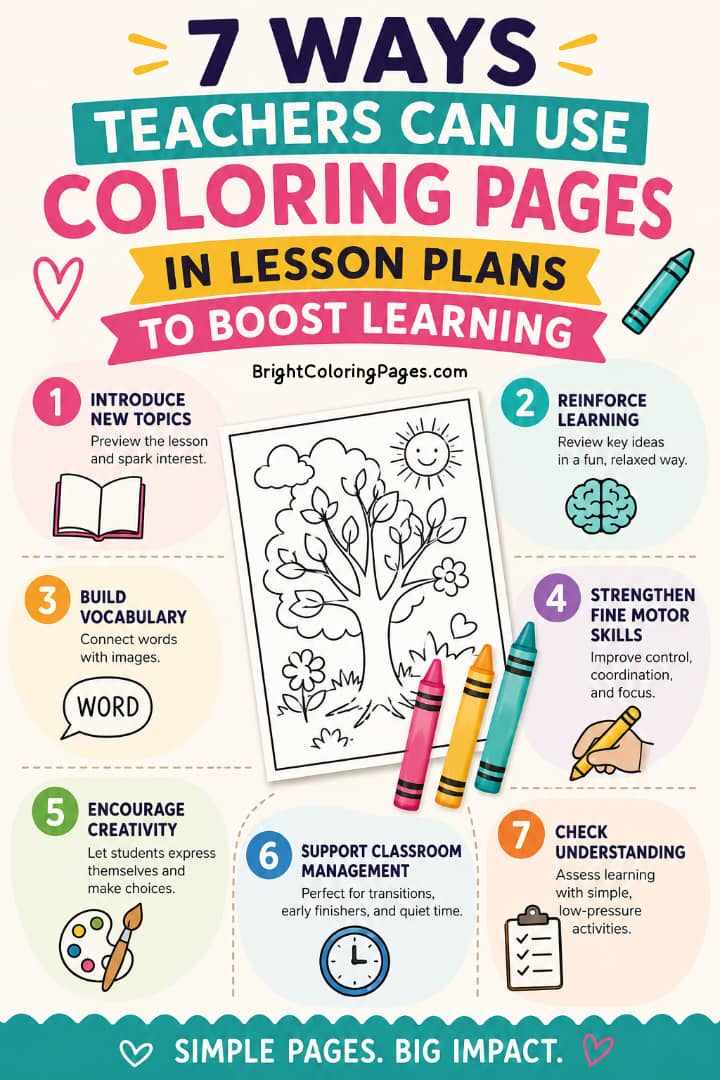
- Coloring pages can support lesson plans in more ways than most teachers realize.
- They are useful for introducing topics, reinforcing learning, and building vocabulary.
- They can also improve fine motor skills and keep students calmly engaged.
- Teachers can use them as a quick assessment tool without making the lesson feel stressful.
- The best coloring pages are not just fun; they are intentional teaching tools.
Coloring pages are often seen as a simple classroom extra, but that view sells them short. In the right hands, a coloring page can become a flexible teaching tool that supports learning, keeps students focused, and makes lessons feel more alive.
I have always believed that the best classroom activities do more than fill time. They help students understand, remember, and connect with what they are learning. Coloring pages can do exactly that when they are used with purpose.
So how can teachers make the most of them?
Let us look at seven practical ways coloring pages can fit into lesson plans in a smart, meaningful way.
1. As a gentle introduction to a new topic
A coloring page can be a great way to warm students up before a lesson begins. Instead of starting with a lot of talking or notes, the teacher can hand out a page connected to the subject.
For example, if the class is about the solar system, students might color planets before the teacher explains them. If the lesson is about farm animals, they can color cows, chickens, and horses while getting familiar with the topic.
This works especially well for younger children because it lowers tension. The activity feels simple, friendly, and non-threatening. Students get a visual preview of what they are about to learn, and that makes the lesson easier to follow.
A good question to ask here is: What can students see, color, and notice before the teaching begins?
2. To reinforce what students have already learned
Coloring pages are not only useful at the start of a lesson. They are also powerful after the main teaching is done.
Once students have learned the key ideas, a coloring page gives them a chance to review those ideas in a relaxed way. This repetition matters. Learning sticks better when students see, hear, and do something more than once.
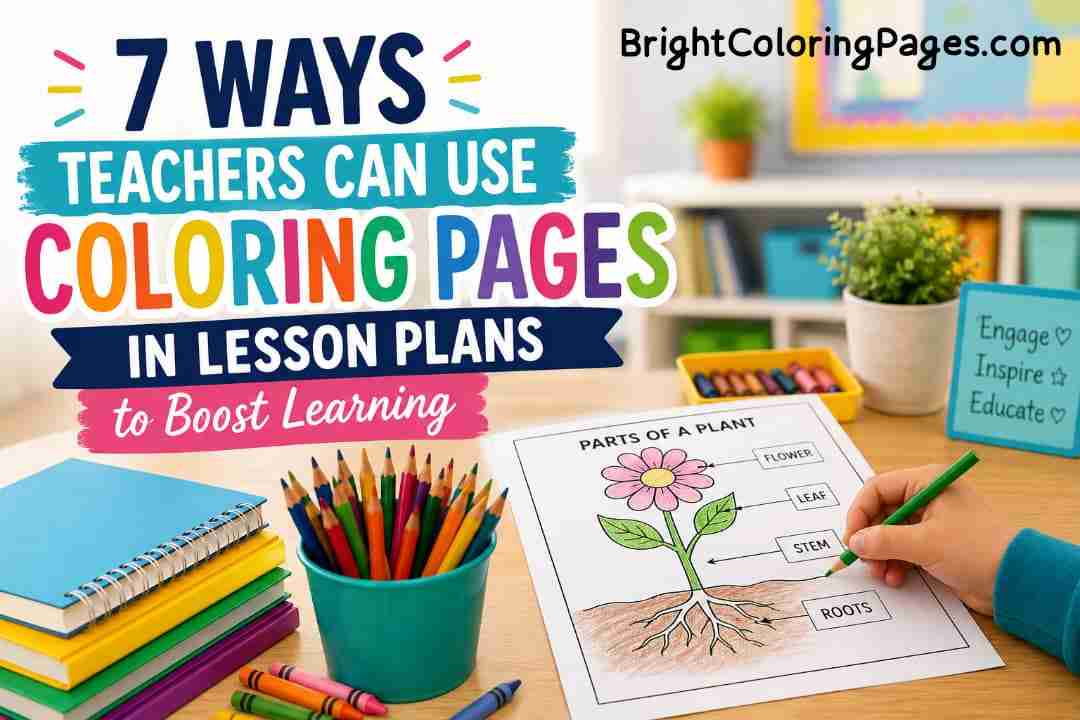
For instance, after a math lesson on shapes, students can color circles, triangles, squares, and rectangles. After a science lesson on plant parts, they can color the roots, stem, leaves, and flower while naming each one.
This kind of activity helps students remember what was taught without feeling like they are doing another test.
3. To build vocabulary in a visual way
Words become easier to understand when they are linked to images. That is one reason coloring pages work so well for vocabulary building.
Teachers can add labels, short words, or simple sentences around the image. Students then connect the word with the picture as they color. This is helpful in many subjects, especially language arts, science, social studies, and early reading.
A page about the body, for example, might include words like “head,” “arm,” “hand,” and “foot.” A page about weather might include “sunny,” “cloudy,” “rainy,” and “windy.”
This is a small change, but it makes a big difference. Students are not just coloring a picture. They are building word recognition and understanding at the same time.
4. To strengthen fine motor skills
One of the most practical benefits of coloring pages is that they help students practice fine motor control. That matters a lot, especially for younger learners who are still developing hand strength and coordination.
Holding crayons, staying inside the lines, and making controlled movements all help build the skills students need for writing. Coloring also improves hand-eye coordination and concentration.
Teachers do not always need to announce this as a skill-building activity. Sometimes the best learning happens quietly. A child may think they are just having fun, while in reality they are strengthening the muscles and control needed for future classroom tasks.
That is a win on both sides.
5. To encourage creativity and personal expression
Not every coloring page has to have one “correct” result. In fact, one of the best things about coloring is that it gives students room to make choices.
They can choose colors, patterns, and styles. They can decide whether their tree should be green, purple, or rainbow. They can make a classroom project feel personal.
This is especially valuable in lessons that may otherwise feel rigid. A creative element gives students a sense of ownership. It says, “Your idea matters too.”
Teachers can even ask simple reflection questions such as:
- Why did you choose those colors?
- What does your picture show about the lesson?
- Which part was your favorite to color?
These questions invite students to think more deeply without turning the activity into pressure.
6. To support classroom management and quiet transitions
Every teacher knows that classroom energy changes throughout the day. Students may finish work at different times, get restless between lessons, or need a calm reset.
Coloring pages are excellent for these moments.
They can be used for early finishers, quiet time, indoor recess, or as a bridge between two larger activities. Instead of letting the room become noisy or scattered, teachers can offer a coloring page that keeps students occupied in a calm, productive way.
This is not about filling empty time for the sake of it. It is about using a low-stress activity to maintain focus and order while the class moves from one part of the day to another.
7. To check understanding in a simple, low-pressure way
Coloring pages can also function as a form of assessment. Not every check for understanding has to look like a quiz or worksheet with lots of writing.
Teachers can create coloring pages with instructions such as:
- Color the animals that live on land.
- Color the parts of the flower in the correct order.
- Color the nouns blue and the verbs red.
- Color the shapes that have three sides.
These tasks help teachers see whether students understand the lesson. At the same time, students feel like they are doing an activity rather than taking a test.
That matters. When students are relaxed, they often show what they truly know more clearly.
Making coloring pages work better in lesson plans
To get the most value from coloring pages, the key is to use them intentionally. A random page may be fun, but a thoughtful page supports learning.
Teachers should ask:
- What is the purpose of this page?
- What skill or idea is it supporting?
- How will I connect it to the lesson?
- What should students notice while coloring?
When those questions are answered clearly, a coloring page becomes more than an extra. It becomes part of the teaching plan.
Conclusion
Coloring pages may look simple, but their value in the classroom is bigger than many people think. They can introduce a topic, reinforce learning, build vocabulary, improve fine motor skills, encourage creativity, support calm transitions, and even help teachers assess understanding.
The best lesson plans are often the ones that combine learning with engagement. Coloring pages do that beautifully when they are chosen with care and connected to a clear purpose.
So the next time you are planning a lesson, do not overlook the coloring page. Used well, it can turn a quiet activity into a meaningful part of learning.
Frequently Asked Questions
No. Younger students benefit the most, but older students can use coloring pages too, especially for review, vocabulary, or subject-based activities.
They support learning by making ideas visual, reinforcing key concepts, improving focus, and giving students a hands-on way to interact with the lesson.
Yes. They work well in science, math, reading, social studies, health, and even character education.
An effective coloring page matches the lesson objective. It should support what students are learning, not just fill time.