- Coloring pages can do much more than keep preschoolers busy.
- When used well, they can help children practice letters, numbers, colors, shapes, vocabulary, and fine motor skills.
- They also make learning feel playful instead of forced.
- A single page can turn into a mini lesson, a language activity, or even a counting game.
- In my observation, that is one of the biggest strengths of coloring pages: they are simple, flexible, and easy to adapt for different children.
Introduction
A lot of people think of coloring pages as quiet time activities, and that is true. But for preschool learning, they can be much more than that.
A good coloring page can become a teaching tool, a conversation starter, and a hands on learning activity all at once. If you are a parent, teacher, or caregiver, you already know how important it is to keep learning fun at this age. Preschoolers learn best when they are moving, talking, noticing, and doing.
That is exactly where coloring pages shine.
With the right approach, a simple printable can help a child recognize letters, count objects, name colors, practice holding a crayon, and build confidence. And the best part is that you do not need anything fancy. Just paper, crayons or pencils, and a little creativity.
Let’s look at how to use coloring pages for preschool learning in a way that feels natural, playful, and effective.
Why Coloring Pages Work So Well for Preschool Learning
Preschoolers are still learning how to focus, follow directions, and use their hands with control. That means they need activities that are clear, simple, and engaging.
Coloring pages work well because they give children a visual starting point. The page already has structure, so the child does not need to figure out what to do next. That makes it easier to begin and easier to stay involved.
They also support active learning. A child can see a picture, hear a word, say it aloud, count it, color it, and talk about it. That kind of repetition helps ideas stick.
Just so you know, preschool learning does not have to look formal to be effective. Some of the best learning happens when children think they are just having fun.
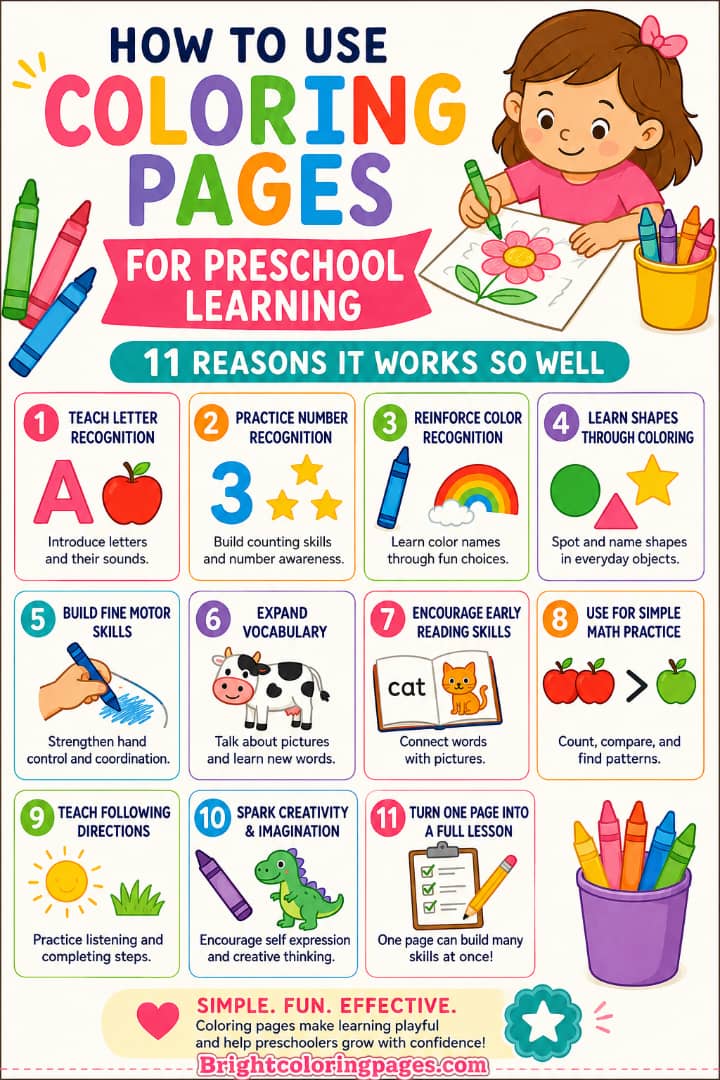
1. Teach Letter Recognition
Alphabet coloring pages are an easy way to introduce letters.
You can ask a child to color every A in one color, every B in another, or just focus on the featured letter of the day. Say the letter sound while you color together. Point to the letter, trace it with a finger, and repeat it out loud.
You can also connect the letter to real life. For example, if the page is about the letter B, ask: “Can you think of something that starts with B?” Then help them name things like ball, bear, or book.
That kind of simple talk turns a coloring page into a mini literacy lesson.
2. Practice Number Recognition
Number coloring pages can help preschoolers become more comfortable with counting and number symbols.
If a page has the number 3, ask the child to find three objects on the page. If the picture shows five apples, count them together before coloring. You can also ask them to color each number in a different way, such as using one color for odd numbers and another for even numbers later on.
The goal is not to rush. The goal is to build number awareness slowly and naturally. Children at this age learn best when counting feels like part of a game.
3. Reinforce Color Recognition
Coloring pages are a perfect way to teach color names.
You can say, “Can you find something yellow?” or “Let’s color the flower pink.” For children who are still learning color words, repeating the names while they color is very helpful.
A fun idea is to make a matching challenge. Ask the child to find all the things that should be blue, then all the things that should be green. This makes the activity more interactive and keeps attention going.
Color recognition is one of the easiest preschool skills to teach with coloring pages because children enjoy making choices.
4. Learn Shapes Through Coloring
Shapes are everywhere in preschool learning, and coloring pages make them easier to notice.
Use pages with circles, stars, hearts, squares, triangles, and rectangles. Ask questions like, “Can you point to the circle?” or “How many stars do you see?”
You can even turn shape spotting into a game before the coloring starts. Say, “Let’s find all the triangles first.” That gives the child a purpose and builds observation skills.
As far as I am concerned, this is one of the smartest ways to use coloring pages, because children often remember shapes better when they discover them on their own.
5. Build Fine Motor Skills
Coloring is excellent for developing fine motor control.
When preschoolers hold crayons, move them across a page, and try to stay inside lines, they are strengthening the small muscles in their hands and fingers. That matters because those same muscles will later help them with writing, cutting, buttoning, and other everyday tasks.
This is why coloring is not just an art activity. It is also preparation for school readiness.
Do not worry if a child scribbles outside the lines or uses a very loose grip at first. That is part of the learning process. What matters is that they keep practicing.
6. Expand Vocabulary
One of the easiest ways to turn coloring into learning is to talk about the picture.
If the page shows a farm scene, ask: “What animals do you see?” “Where do they live?” “What sound does this animal make?” If it shows a vehicle, ask what the vehicle does or where it goes.
These small conversations build vocabulary in a natural way. Children hear new words, repeat them, and connect them to images. That makes language learning feel much more real.
7. Encourage Early Reading Skills
Even before children can read on their own, coloring pages can support early reading habits.
You can point to labels, simple words, or short instructions and read them aloud. If the page says “cat,” say the word together before the child colors the cat. If the page includes a sentence, read it slowly and clearly.
This helps preschoolers understand that print has meaning. They start to see words as part of everyday learning, not just something on a worksheet.
8. Use Coloring Pages for Simple Math Practice
Coloring pages can be quietly helpful for early math too.
You can ask children to count the objects on the page, compare which group has more, or sort items by color. For example, “How many ducks are there?” or “Which group has more apples?”
You can also look for patterns. If a page has repeating shapes or objects, ask the child what comes next. These small math questions help build number sense without overwhelming them.
9. Teach Following Directions
Preschoolers are still learning how to listen carefully and follow instructions.
Coloring pages give you a gentle way to practice that skill. You can say, “Color the sun yellow,” then “Now color the grass green.” Keep directions short and clear.
This is especially helpful because it teaches children how to listen, pause, and complete a task step by step. Those are important classroom skills.
10. Spark Creativity and Imagination
Coloring pages are structured, but they still leave room for creativity.
Ask open ended questions like, “What story is happening here?” or “What name would you give this character?” You can also let children choose unusual colors if they want to. A purple tree or a blue cat does not ruin the activity. In many cases, it makes it more fun.
That creative freedom helps children feel confident and engaged. It also reminds them that learning can be playful.
11. Turn One Coloring Page Into a Full Learning Activity
Here is a simple example.
Imagine you have an animal coloring page. You can start by naming the animal. Then ask the child what sound it makes. Count its ears, legs, or spots. Talk about where it lives. Read a short fact if you have one. Finally, let the child color it.
In one activity, you have covered language, counting, observation, listening, and creativity.
That is the beauty of coloring pages. One page can open the door to several learning moments.
Easy Tips for Parents and Teachers
Keep coloring sessions short, especially for younger preschoolers. Ten to fifteen minutes is often enough.
Let children choose pages they actually enjoy. Offer praise for effort, not perfection. Ask questions while they color, but do not turn the activity into a quiz.
The best coloring lessons feel light and encouraging. Children should feel successful, curious, and proud of what they made.
Conclusion
Coloring pages are much more than a way to pass the time. Used well, they can support preschool learning in a simple, practical, and enjoyable way.
They can help children recognize letters and numbers, learn colors and shapes, build vocabulary, improve fine motor skills, and practice following directions. They also give children a chance to express themselves while learning through play.
If you have been overlooking coloring pages, this is a good time to give them a second look. With a little intention, they can become one of the easiest and most useful tools in your preschool learning routine.
FAQs
Yes, they can support early learning in many areas, including letters, numbers, shapes, colors, vocabulary, and fine motor skills.
Preschoolers can practice pencil control, hand strength, color recognition, shape recognition, counting, listening, and creativity.
Short sessions work best. For many preschoolers, ten to twenty minutes is enough, depending on their age and interest.
Yes. Coloring helps children build the hand control and coordination they need for early writing skills later on.