
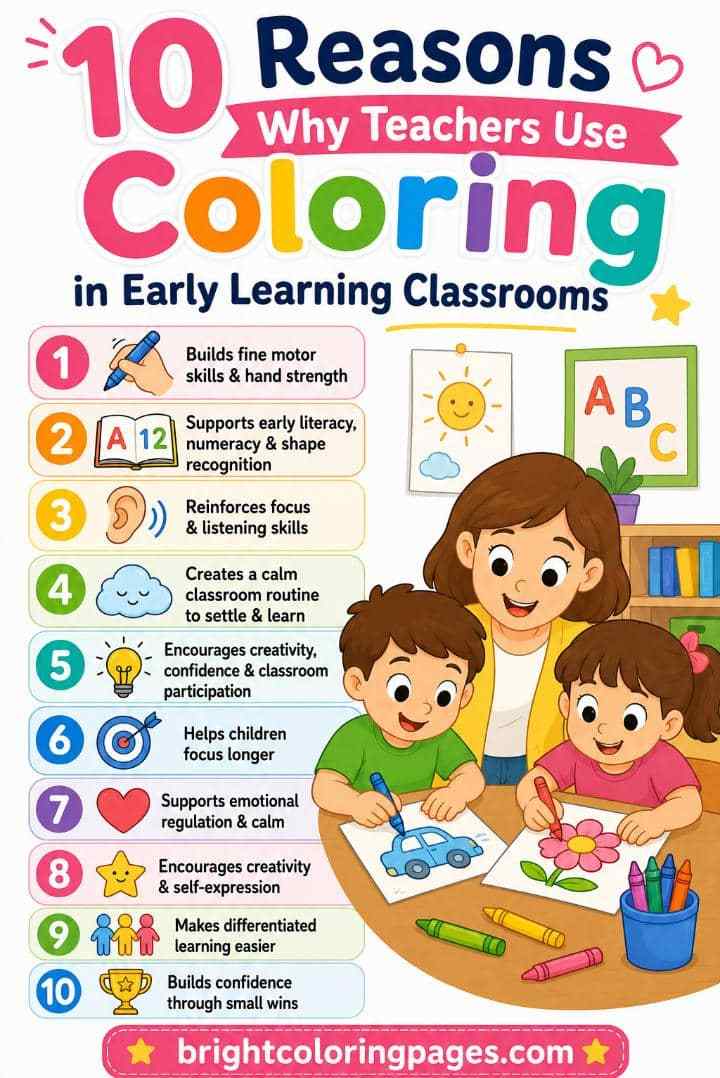
- Coloring helps young children build fine motor control and hand strength.
- It supports early literacy, numeracy, and shape recognition.
- Coloring gives teachers an easy way to reinforce focus and listening skills.
- It creates a calm classroom routine that helps children settle and learn.
- It encourages creativity, confidence, and classroom participation.
Introduction
Coloring is one of those classroom activities that looks simple at first glance, but teachers know it can do a lot more than keep little hands busy.
In early learning classrooms, every activity has a purpose. Teachers are not just looking for ways to fill time. They are looking for tools that help children grow, learn, listen, and feel successful. That is exactly why coloring shows up so often in preschool, kindergarten, and early primary settings.
From my experience, the best classroom activities are usually the ones that feel natural to children but still support real learning. Coloring does that beautifully. It gives young learners something familiar and enjoyable while helping them practice skills they will use again and again.
A child may think they are simply filling in a picture of an apple, a dinosaur, or a happy sun. A teacher, on the other hand, may be using that same page to support letter recognition, color names, hand control, attention, vocabulary, and even emotional regulation.
That is the real strength of coloring in early learning classrooms. It is simple, flexible, and deeply useful.
Let’s look at why teachers rely on it so often and why it continues to be such a valuable part of early education.
Why Coloring Matters in Early Learning
Early learning is a stage where children are developing fast. They are learning how to hold crayons, follow directions, name colors, recognize shapes, listen to instructions, and stay with a task long enough to finish it.
Coloring fits perfectly into that stage because it meets children where they are.
It does not ask for advanced reading skills. It does not require expensive materials. It does not overwhelm children with too many steps. Instead, it offers structure with just enough freedom to keep them interested.
In my view, that balance is one of the main reasons teachers keep using coloring across different age groups and classroom settings.
1. Coloring Builds Fine Motor Skills
One of the biggest reasons teachers use coloring is that it strengthens the small muscles in children’s hands and fingers.
When a child holds a crayon, controls pressure, and moves it across the page, they are developing the same hand skills they will later need for writing, cutting, and other classroom tasks.
This is especially important in early learning, because many children are still figuring out how to grip a pencil properly. Coloring gives them safe, repeated practice without pressure.
A teacher might not say, “We are working on hand strength today,” but that is exactly what is happening.
2. It Helps With Early Writing Readiness
Before children can write letters neatly, they need to learn control.
Coloring helps with that control by teaching children how to move their hands more carefully and intentionally. Staying inside a shape, tracing a line, or coloring one section at a time helps prepare the brain and hand for writing later on.
Think of it like this: coloring is not writing, but it prepares the foundation for writing.
That is why many teachers use coloring pages before introducing more formal pencil work.
3. It Reinforces Letter and Number Recognition
Coloring pages can easily turn into learning pages.
Teachers often use alphabet coloring sheets, number pages, or themed printables to help children recognize letters and numbers in a fun way. A child might color the letter A while saying its sound out loud, or count objects on a page while coloring them in.
That makes learning feel less like a test and more like a game.
Here is something most people miss: young children often remember information better when it is connected to an activity they enjoy. Coloring gives teachers a simple way to make that connection.
4. It Supports Shape and Color Learning
Coloring is also a strong visual learning tool.
Teachers can use it to teach basic colors, shapes, and visual patterns. A child can find circles, squares, stars, and triangles while coloring. They can also practice naming colors and matching them to objects.
For example, a teacher may ask, “What color is the apple?” or “Can you find all the circles on the page?”
These small questions build observation skills and keep children actively involved.
That is one of the smartest things about coloring. It is quiet, but it is never empty. There is always something to notice, name, compare, or describe.
5. It Encourages Listening and Following Directions
Early learning classrooms place a lot of emphasis on following simple instructions.
Coloring is a great way to practice that.
Teachers might say, “Color the sun yellow,” then “Now color the grass green,” or “Circle the biggest animal before you color it.” These are short, manageable directions that help children learn how to listen carefully and respond step by step.
That skill matters far beyond coloring time. It helps children during group lessons, transitions, cleanup, and classroom routines.
Coloring gives teachers a gentle way to build that habit without turning it into a stressful task.
6. It Helps Children Focus Longer
Young children naturally have short attention spans, and that is perfectly normal. Coloring helps because it gives them a clear task they can work on independently for a few minutes at a time.
The page provides structure. The child knows what to do. That makes it easier to stay focused.
Teachers like coloring because it helps children practice sitting with one activity, finishing something, and not jumping away too quickly. Those are important classroom skills.
If you have ever watched a child become completely absorbed in coloring, you already know how powerful that focus can be.
7. It Creates a Calm Classroom Atmosphere
Classrooms can get noisy, busy, and overstimulating, especially in early childhood settings.
Coloring gives the room a quieter rhythm.
It can be used during transitions, calm down time, early finishers, or indoor recess. It helps children settle their bodies and minds without making them feel isolated or punished.
Just so you know, that calm feeling is not only helpful for behavior. It also helps learning. Children often absorb instructions and information better when they feel settled.
That is why teachers often reach for coloring when the room needs to slow down a little.
8. It Encourages Creativity and Personal Expression
Coloring pages may be structured, but they still leave room for choice.
Children can decide which colors to use, how to fill the picture, and sometimes even whether they want to follow realistic color rules or create something imaginative. A purple cat or a blue tree may not look “real,” but it shows creativity and confidence.
Teachers value that freedom because it helps children feel ownership over their work.
When a child says, “Look what I made,” that is more than a finished page. That is a moment of pride.
9. It Makes Differentiated Learning Easier
Every classroom has children with different needs, strengths, and learning styles.
Coloring works well because it can be adapted easily. Some children may color simple large shapes, while others work on more detailed pages. Some children may focus on matching colors, while others practice counting or identifying letters.
That flexibility makes coloring a very practical classroom tool.
Teachers do not have to redesign the whole lesson to meet different learners. One page can be used in several different ways depending on the child.
10. It Builds Confidence Through Small Wins
Early learning should help children feel capable.
Coloring can do that.
A child does not have to complete a difficult worksheet to feel successful. Sometimes finishing a coloring page, choosing colors independently, or staying focused until the end is enough to build confidence.
Those small wins matter.
A child who feels successful is more likely to stay engaged, try again, and participate more fully in the classroom.
That is one reason teachers use coloring so often. It gives children a chance to succeed in a way that feels approachable.
Simple Ways Teachers Use Coloring in Class
Teachers often use coloring during morning work, theme units, alphabet lessons, number activities, quiet time, centers, or after a storybook reading.
They may pair coloring with questions, songs, vocabulary words, or counting games. They may also use it as a transition activity when children need a calm reset.
The beauty of coloring is that it can fit almost anywhere in the school day.
Conclusion
Teachers use coloring in early learning classrooms because it does far more than entertain children. It supports motor development, early literacy, number recognition, listening, focus, creativity, and confidence.
The real takeaway here is that coloring is a simple tool with a surprising number of benefits. It gives teachers a practical, low stress way to support learning while keeping children engaged and comfortable.
In my opinion, that is exactly the kind of classroom activity that deserves a permanent place in early education.
FAQs
Why do teachers give coloring pages to young children?
Teachers use coloring pages to support fine motor skills, focus, creativity, and early learning concepts like letters, numbers, and shapes.
Is coloring actually educational in early learning classrooms?
Yes. Coloring helps children practice skills that matter for school readiness, including hand control, attention, and visual recognition.
How does coloring help classroom behavior?
Coloring can help children calm down, stay focused, and settle into a quieter routine, which supports smoother classroom management.
Can coloring support literacy and math?
Absolutely. Teachers often use coloring pages for letter recognition, number practice, counting, shape learning, and vocabulary building.
Why do children enjoy coloring so much?
Coloring feels fun, safe, and easy to understand. It gives children a chance to make choices and create something of their own.